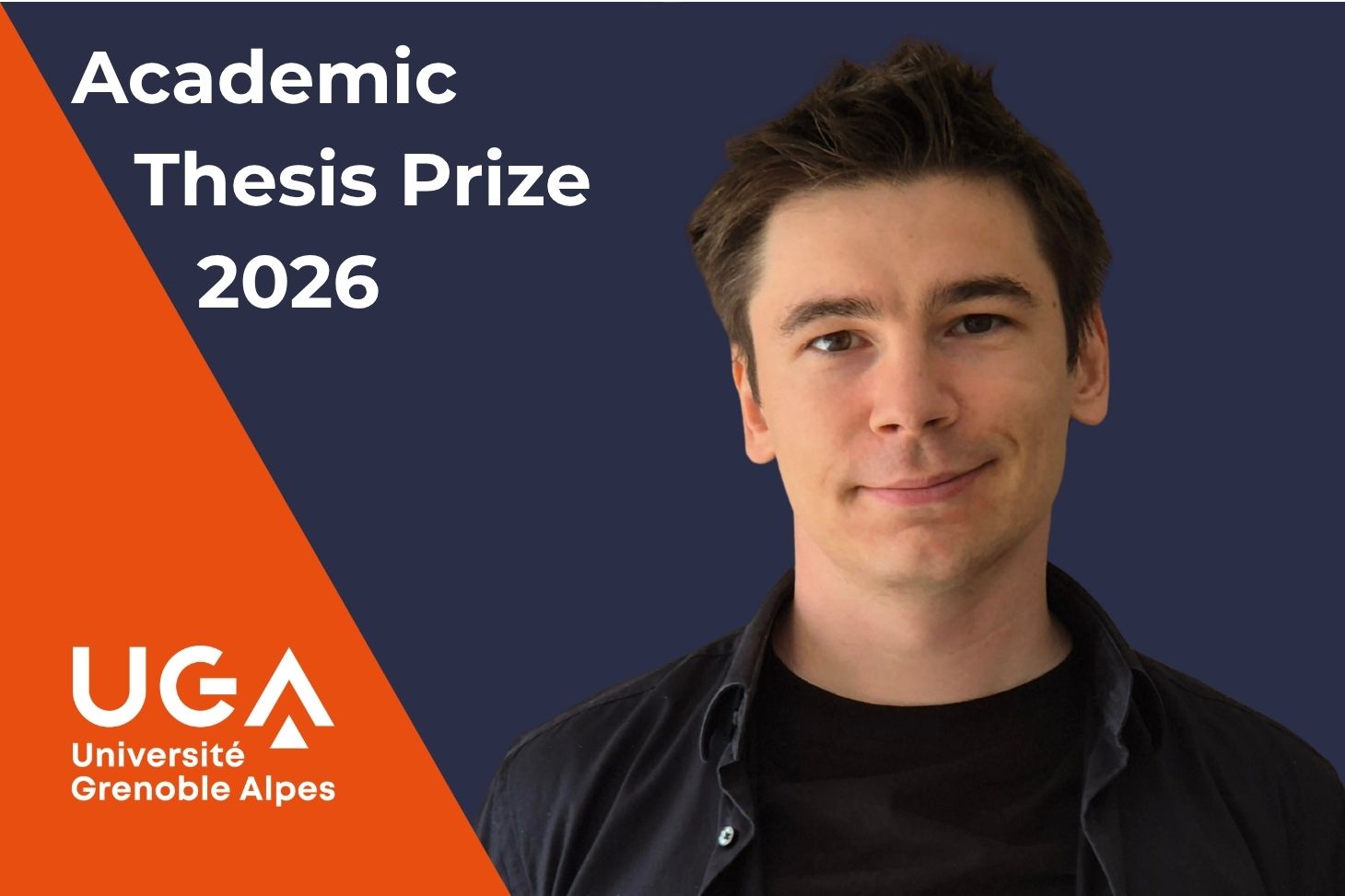
Anton Khvalyuk received the 2026 Academic Thesis Prize for his research work among PhDs graduating in 2025.
His Thesis Title: Low-energy theory of strongly disordered superconductors
Scientific Context and Objectives
Superconductivity in strongly disordered systems (SDSCs) exhibits significant deviations from the predictions of conventional semi-classical (BCS) theory. While standard theory predicts an exponential suppression of thermal dependencies by the Boltzmann factor, SDSCs display anomalous behaviors, notably a power-law growth of kinetic inductance (LK) with temperature and unexpected energy losses at low temperatures. These phenomena limit the coherence of current quantum devices, such as qubits and microwave resonators. This thesis aims to establish an analytical theoretical framework to elucidate the origin of these anomalies.
Theoretical Advances: Localized Cooper Pairs
The research of Anton identifies a new type of localized collective excitations, resulting from the local hopping of Cooper pairs between nearby regions where superconductivity is locally suppressed by disorder.
Disorder Modeling: the study demonstrates that the spectral density of these excitations is intimately tied to the non-trivial statistical distribution of spatial inhomogeneities.
Inductance Explanation: this mechanism explains the thermal growth of LK, reconciling experimental observations with a microscopic description of the electromagnetic response.
Dissipation Mechanisms and Quantum Optimization
A major contribution of Anton thesis involves the understanding of dissipation within SDSCs. The research establishes that localized excitations structurally behave as two-level systems (TLS) due to the dipole moment formed by the charge of Cooper pairs and the spatial extent of their tunneling. This mechanism explains the unusual dependency of thermal dissipation. Furthermore, the theory predicts that reducing the frequency leads to a sharp decrease in dissipation. These findings offer a direct pathway to at least double the coherence time of quantum devices based on SDSCs.
Conclusion and Perspectives
Anton thesis provides significant advances both fundamentally, by clarifying the interplay between strong disorder and superconductivity, and practically. His results offer concrete guidelines for designing high-performance photon detectors and qubits, which are essential for the development of next-generation quantum computing technologies.
Doctoral School: ED PHYS – Physics Research laboratory: Laboratoire de physique et modélisation des milieux condensés (LPMMC - CNRS/UGA) Thesis supervision: Denis Basko and Benjamin Sacépé
Share the linkCopyCopiedClose the modal windowShare the URL of this pageI recommend:Consultable at this address:La page sera alors accessible depuis votre menu "Mes favoris".Stop videoPlay videoMutePlay audioChat: A question? Chatbot Robo FabricaMatomo traffic statisticsX (formerly Twitter)
 Learning by Research