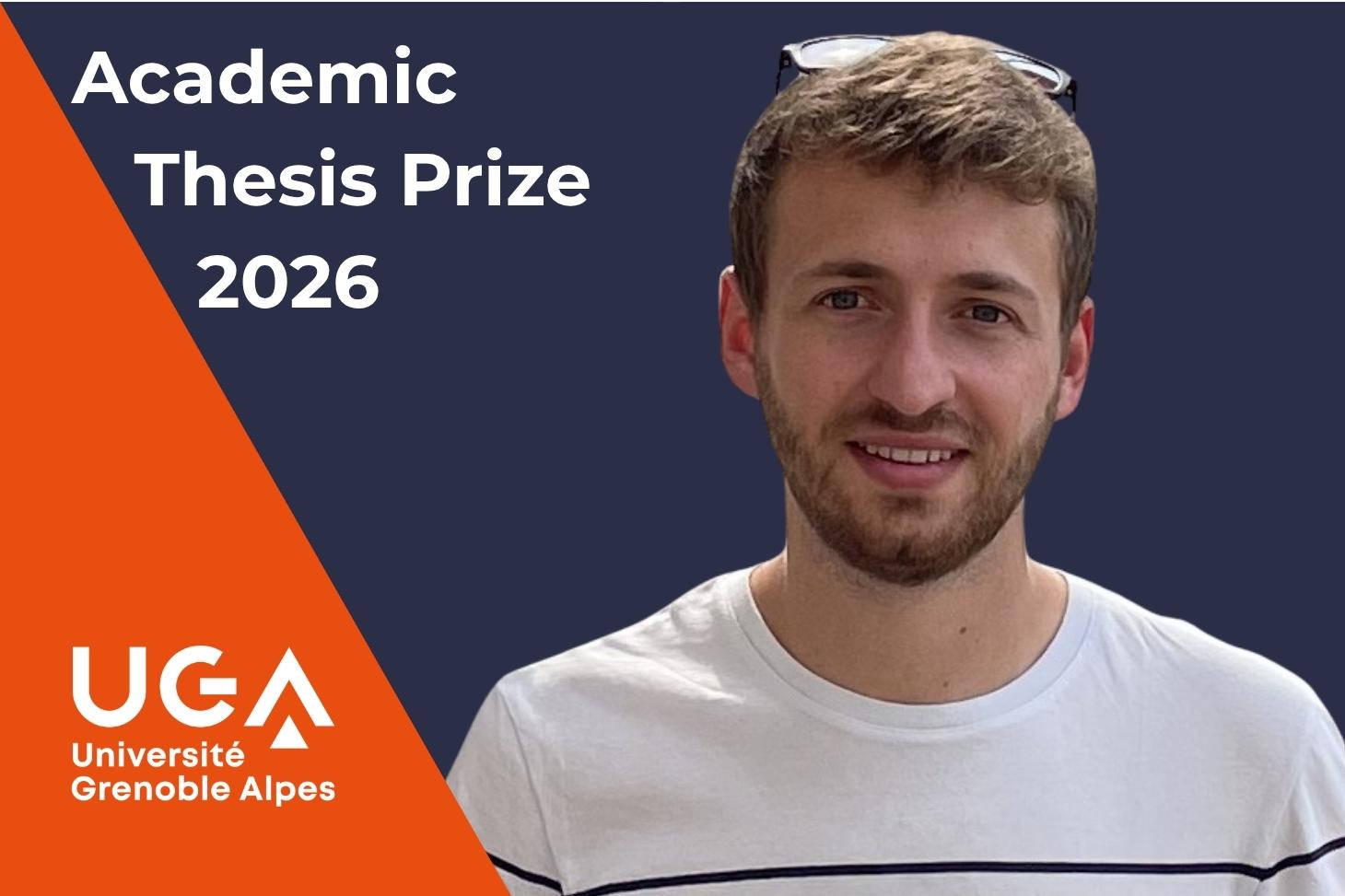
Corentin Renais received the 2026 Academic Thesis Prize for his research work among PhDs graduating in 2025.
His Thesis Title: Understanding Kinetic Limitations in the Graphite Electrode: From Material Properties to Electrode Microstructure
Scientific Context and Objectives
The mass adoption of electric mobility is hindered by mass transport constraints within Li-ion batteries, particularly during fast charging where ionic throughput becomes the limiting factor compared to volumetric storage capacity. Corentin’s thesis explores the technological bottlenecks associated with the graphite electrode, demonstrating that restrictions on high-rate charging are not solely intrinsic to the active material. Instead, they result from a complex synergy between the porous electrode architecture, the establishment of ionic concentration gradients in the electrolyte, and the structural morphological changes of the insertion material.
In Operando Characterization Methodology
To address the opacity of internal mechanisms, an innovative in operando characterization methodology was developed during Corentin’s research. This setup couples high-resolution electrode thickness measurement with ultrasound transmission analysis, enabling non-invasive probing of the cell's mechanical properties during operation. This approach notably tracks the evolution of the Young’s modulus of graphite during lithiation, providing a precise acoustic signature of phase transitions and internal mechanical stresses.
Results and Structural Analyses
The investigations carried out highlight several critical points for performance optimization:
Mass transfer resistance: the decisive impact of pore tortuosity on insertion kinetics.
Electro-mechanical coupling: the correlation between the crystalline phase changes of graphite and its volumetric expansion.
Acoustic monitoring: the sensitivity of the ultrasonic signal to local variations in the state of charge (SoC).
Health diagnostics: the potential of ultrasound for early detection of degradation (SoH) in commercial cells.
Conclusion and Industrial Perspectives
In summary, Corentin’s research demonstrates that overcoming fast-charging limitations requires rethinking electrode engineering to promote homogeneous ion diffusion while minimizing mechanical stress. Beyond the fundamental aspects, the use of ultrasound emerges as a promising technique for real-time battery monitoring. His work thus paves the way for the development of higher-performance Battery Management Systems (BMS), capable of optimizing charging speeds without compromising cell longevity.
Doctoral School: ED IMEP2 – Engineering - Materials, Mechanical, Environment, Energetics, Processes, Production Research laboratory: Laboratoire d'électrochimie et physicochimie des matériaux et des interfaces (Lepmi - CNRS/UGA ̶ Grenoble INP-UGA/USMB) Thesis supervision: Claire Villevieille, Fannie Alloin and Céline Barchasz
Share the linkCopyCopiedClose the modal windowShare the URL of this pageI recommend:Consultable at this address:La page sera alors accessible depuis votre menu "Mes favoris".Stop videoPlay videoMutePlay audioChat: A question? Chatbot Robo FabricaMatomo traffic statisticsX (formerly Twitter)

 Learning by Research