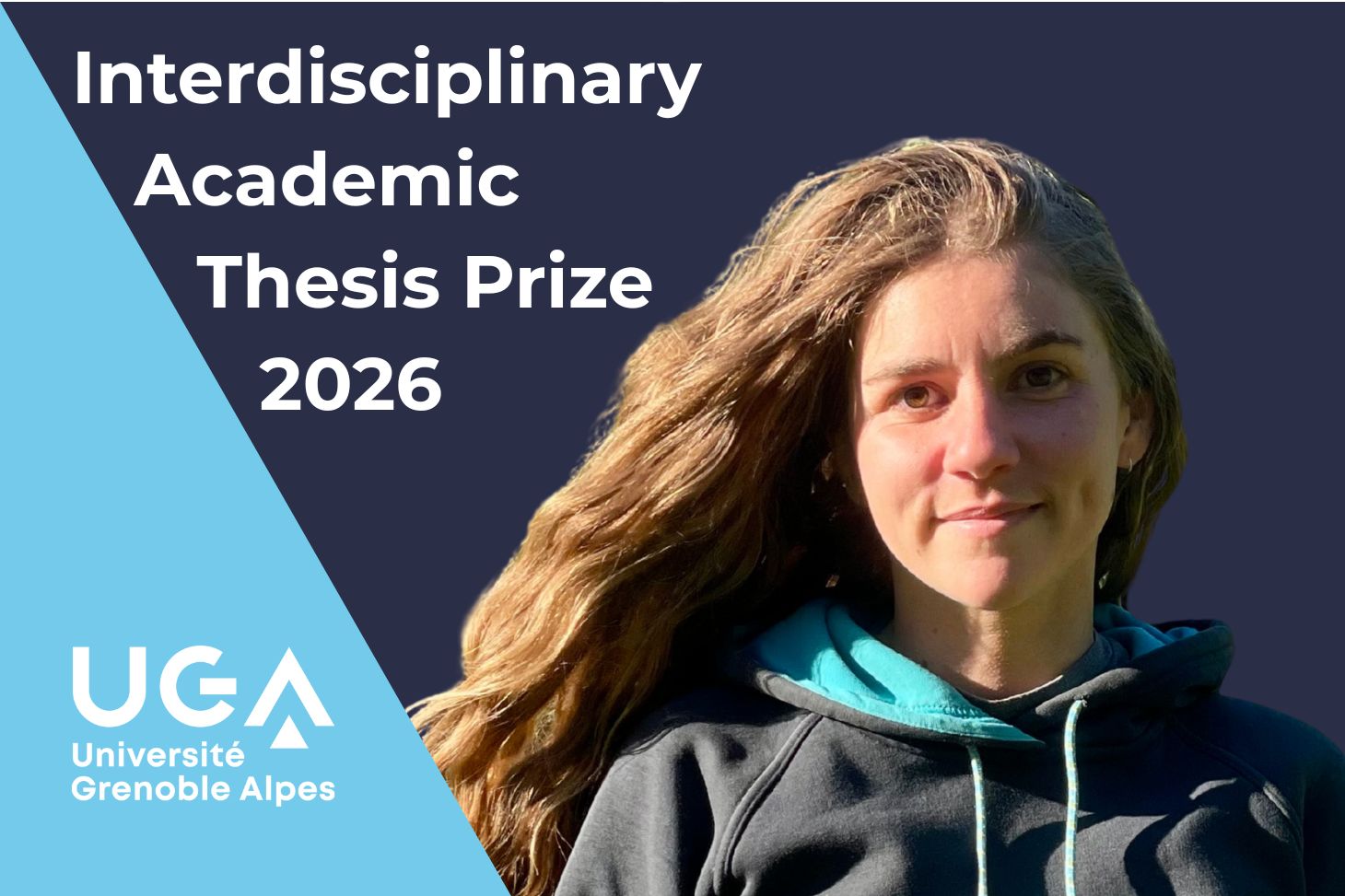
Manon Lorcery received the 2026 Interdisciplinary Academic Thesis Prize for his research work among PhDs graduating in 2025.
Her Thesis Title: The scaling of biodiversity through time and space: environmental, evolutionary, and ecological interactions
An Unequal Distribution of Life
Why is biodiversity particularly rich in the tropics? This question, central to ecology, is rooted in the deep history of our planet. Today’s biodiversity is the result of millions of years of interactions between living organisms and a constantly changing Earth: the movement of continents, the formation of mountains, and climatic shifts. Manon’s thesis explores how these environmental dynamics have shaped the major patterns of terrestrial mammal distribution over the last 125 million years.
Numerical Models for Traveling Back in Time
To overcome the limitations of often fragmentary fossil records, Manon’s work relies on the development of innovative numerical models. By combining past reconstructions of climate, tectonics, and geomorphology, these simulations allow for the testing of biological processes (dispersal, speciation, extinction) across the ages. Her results confirm that the exceptional concentration of species in tropical regions—known as the latitudinal diversity gradient—has been a stable feature of our planet for at least 125 million years, acting as both a "cradle" (where new species emerge) and a "refuge" (where they persist over the long term).
Biodiversity Hotspots and Evolutionary Strategies
At a regional scale, the richness of biodiversity "hotspots" is explained by the specific history of their landscapes. While stable environments favor species persistence, it is primarily dynamic landscapes—such as forming mountain ranges and complex river networks—that stimulate the appearance of new species. Manon’s thesis also highlights the importance of individual strategies: while "generalist" species dominate the globe due to their broad tolerance, "specialist" species, adapted to very specific mountain or climatic conditions, are the true pillars of regional diversity.
An Integrative Vision of the Earth-Life System
Interdisciplinarity is the very foundation of Manon’s research. By refusing to simply juxtapose different fields, her thesis merges Earth Sciences (climatology, geodynamics, geomorphology) with Life Sciences (ecology, evolutionary biology). Physical transformations of the Earth's surface are no longer treated as simple external variables, but as dynamic drivers coupled with living systems. This "Humboldtian" approach moves beyond traditional silos to model a coupled Earth-Life system where geology and biology explicitly interact to produce the biological complexity we observe today.
Key words: tectonic, geomorphology, biodiversity
Doctoral School: ED STEP – Earth, Environmental and Planetary Sciences Research laboratory: Institut des sciences de la Terre (ISTerre - CNRS/IRD/UGA/UGE/USMB) Thesis supervision: Laurent Husson and Tristan Salles
Share the linkCopyCopiedClose the modal windowShare the URL of this pageI recommend:Consultable at this address:La page sera alors accessible depuis votre menu "Mes favoris".Stop videoPlay videoMutePlay audioChat: A question? Chatbot Robo FabricaMatomo traffic statisticsX (formerly Twitter)

 Learning by Research